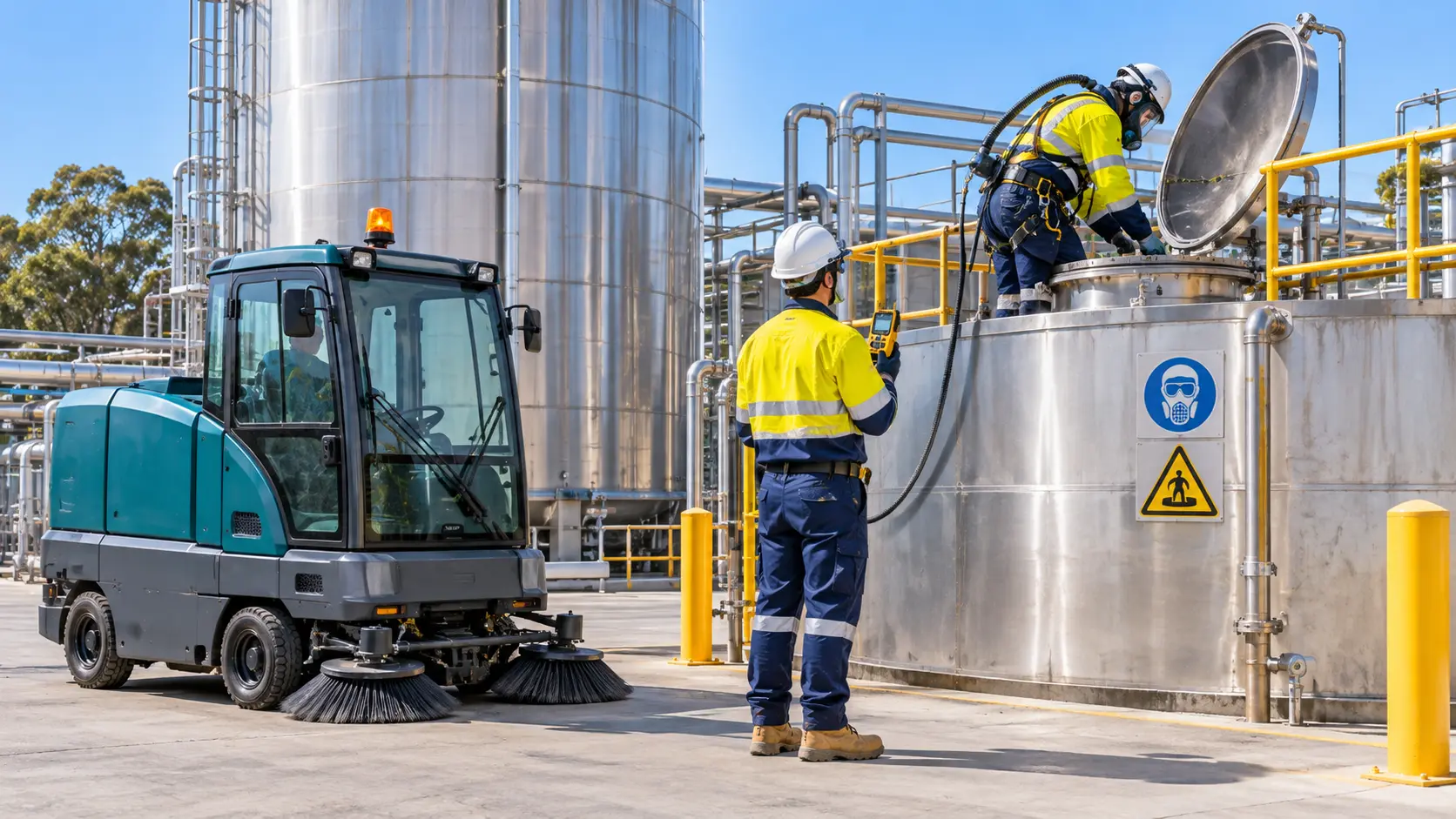
One thing facility managers tell us again and again: they didn’t realise parts of their own plant counted as confined spaces until someone asked who was certified to clean them. A below-ground pump pit, a process tank, a duct, a large equipment housing. Under WA’s WHS rules, if a worker’s head or upper body enters one of those, a whole set of legal requirements kicks in.
That’s why industrial cleaning in Perth for tanks, silos, pits and vessels is specialist work. Here’s what confined space cleaning actually involves, and how to tell whether your site has spaces that fall under the rules.
What Counts as a Confined Space?
According to WorkSafe WA’s confined spaces guidance, it’s an enclosed or partially enclosed space that isn’t designed for a person to occupy, and that poses risk from unsafe oxygen levels, contaminants, fire or explosion, or engulfment. The usual suspects on Perth industrial sites:
- Storage tanks, vats and processing vessels
- Silos and bulk storage bins
- Pits, sumps and below-ground pump stations
- Pipes, ducts, flues and drainage channels
- Large equipment housings and roof voids that meet the definition
The tricky part: it’s the hazards that define the space, not just the size. A roomy tank can be a confined space; a cramped cupboard might not be.
Why Can’t We Just Send Someone In With a Broom?
Because the risks inside aren’t visible. Oxygen can be depleted in minutes by rusting steel or decomposing product. Vapours from residue can be toxic or explosive. Liquids or grain can engulf a worker silently. WorkSafe WA’s confined space risk-management guidance requires that entry only happens under a formal safe system of work, because people have died doing exactly what “just sending someone in” describes.
What Does a Compliant Confined Space Clean Involve?
- Can the work be done without entry? Good question, and often the answer. Spray balls, long-reach tools and flushing from outside can eliminate entry entirely.
- Risk assessment: written, by a competent person, covering atmosphere, engulfment, isolation and rescue.
- Entry permit: issued in writing before anyone goes in, listing the space, the people, the time window and the controls.
- Isolation and purge: machinery, valves and energy sources locked out; atmosphere tested for oxygen, gases and explosive limits.
- Standby person and rescue plan: someone outside, in contact, equipped and ready. Non-negotiable.
- Clean, exit, close out: the permit is formally closed once everyone is out and the space is confirmed clear.
WorkSafe WA publishes a confined spaces safety checklist that walks through all of it, if you want to audit your own site’s readiness.
Who Can Legally Do This Work?
- Workers with current confined space entry training (there’s no “licence”, but training evidence is required)
- Atmospheric monitoring competence
- First aid and rescue training on the crew
- A competent permit issuer supervising the entry
business.gov.au summarises the WHS duties for Australian businesses, but the practical bar is simple: if your in-house team can’t tick every item on the WorkSafe checklist, use a contractor who can. WA Sweeping & Scrubbing’s crews are fully trained and certified for confined space entry, and it’s one of the few services where DIY isn’t just risky, it’s non-compliant.
How Often Do Tanks and Silos Need Cleaning?
It depends on the product and hygiene requirements. Food and pharmaceutical vessels follow their own cleaning validation schedules. General industrial tanks and pits are typically cleaned on inspection cycles or when product changes. The schedule matters less than doing every entry by the book.
FAQ
Q: What is confined space cleaning?
A: Professional cleaning of enclosed spaces with restricted access, like tanks, silos, pits and vessels, done under WA confined space rules with permits, atmospheric monitoring and a standby person.
Q: Does a worker need a licence for confined space work?
A: No formal licence exists, but workers must hold evidence of confined space training, and entry requires a written permit from a competent person.
Q: Can cleaning be done without entering the tank?
A: Often yes. Spray systems, flushing and long-reach tools can clean from outside, and eliminating entry is the first thing WorkSafe expects you to try.
Q: We have pits and ducts, but no tanks. Does this apply to us?
A: Possibly. Sumps, pits, large ducts and equipment housings can all meet the confined space definition. A site assessment settles it.
Q: What happens if there’s an incident in a confined space?
A: Rescuers who rush in unprotected become casualties. That’s why a trained standby person with a rescue plan is mandatory, and why untrained intervention makes things worse.
Get Your Confined Spaces Assessed and Cleaned Properly
WA Sweeping & Scrubbing provides certified confined space cleaning alongside our industrial sweeping, scrubbing and emergency spill removal services. Ask for a quote and we’ll assess which spaces on your site fall under the rules, then clean them compliantly.